If Customer Enablement
is about teaching customers....
CSM Enablement is about teaching
the people who teach the customers.
The CSM Enablement Pyramid
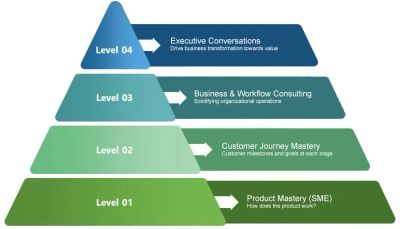
Level 01: Product Mastery
Goal: Product & Platform Mastery
OKR Examples: CSMs demonstrate deep, accurate, and outcome-oriented understanding of the product and platform.
- ≥90% average score on product proficiency assessments across core modules
- 100% of CSMs can correctly map top 20 features to customer business outcomes (validated in role-play or written scenarios)
- <5% of customer escalations are caused by incorrect or incomplete product guidance
- 95% of CSMs can independently configure and troubleshoot standard enterprise use cases in sandbox environments
This is your bottom layer because it is the base for all else to come.
A CSM should know:
- SME-level understanding of every feature
- every workflow
- common configuration options
- release changes
- integrations
- limitations
- competitive differentiators
They shouldn't memorize features. They should understand why customers care about each feature.
Example:
Instead of, "This button exports PSDs.", they should think, "This reduces agency turnaround by 35%". That's outcome knowledge.
Pyramid Level 2: Customer Journey Mastery
Goal: Lifecycle & Adoption Management
OKR Examples: CSMs consistently guide customers through predictable adoption stages that lead to measurable product value realization.
- ≥80% of managed accounts reach defined “First Value” milestone within target timeframe (e.g., 30–60 days)
- 90% of accounts have documented success plans tied to lifecycle stages (onboarding, adoption, expansion)
- Increase average feature adoption breadth by X% within first 6 months post-onboarding
- Reduce time-to-first-key-workflow (e.g., first campaign built, first asset library launched) by X%
Every CSM should understand Adoption stages
Example:
Day 1: implementation, permissions, user setup
Day 30: initial workflows
Day 90: team standardization
Day 180: executive reporting
Day 300 (two months before renewal deadline): expansion
Day 335: define next year expectations; tee-up the renewal
Each stage has risks, expected behaviors, success metrics, and intervention playbooks. A good enablement program teaches, "Here's what a healthy customer looks like this month"... not simply, "Here's how feature X works."
Pyramid Level 3 — Business Consulting
Goal: Organizational Diagnosis & Workflow Change
OKR Examples: CSMs drive measurable improvements in customer creative workflows and operational efficiency through consultative engagement.
- ≥70% of strategic accounts implement at least one CSM-recommended workflow improvement (e.g., approvals, templates, governance)
- Documented improvement in at least one operational KPI (e.g., campaign cycle time, asset reuse rate, review iterations) in 60% of expansion accounts
- ≥75% of QBRs include identified workflow bottlenecks and agreed-upon remediation actions
- Increase customer-reported “operational efficiency” score by X% (via CSAT or survey)
This involves CSMs working with Program Managers, Project Managers, and anyone else in the mid-to-upper management levels. If you are assigned an "R" or "A" in your company's RACI for this program, then this is for you.
A CSM should understand how creative organizations actually function. Creative leaders don't buy software. They buy improvements in campaign velocity, asset reuse, governance (including AI), brand consistency, production costs, localization, and creative ops.
In this stage, CSMs are constantly asking, “Where is the friction actually coming from?”, and “Who has the authority and incentive to change it?” (Thus, this is the stage that informs how they approach Pyramid Level 4.)
Example:
When customers describe problems, they need to understand the corporate structure including the cross-team relationships and operations. The CSM should recognize organizational patterns, not just product problems. (CSMs are not support.)
Pyramid Level 4: Executive Conversations
Goal: Decision Influence & Alignment
OKR Examples:
This is your top layer, and thus the hardest.
This “executive layer” is not about turning CSMs into mini–account executives or giving polished ROI theater. In a healthy program, it’s much narrower, more practical, and more grounded in how enterprise decisions actually get made. In essence, it is about the creation of business meaning and attaching it to operational reality.
The motion here is running structured executive conversations, not “presenting to execs”. Most enablement programs fail here because they teach presentations. The real work is conversation design.
Remember: executives don’t want narration. They want:
- clarity
- prioritization
- tradeoffs
- confidence